
What a St. Louis Park Resident Lookup Confirms
No single St. Louis Park resident lookup establishes every fact about a person. The Hennepin Property Information Search is a sound starting point for a parcel, its situs address, PID, legal description, tax data, sales, and recent-recording links. It can show an owner or taxpayer role, yet that is not a finding that the same person occupies the property. The Minnesota voter registration lookup is narrower: it confirms a current registration only when the entered name, full date of birth, and address match the record. A dated directory entry, court result, or certificate request answers a different question.
| Record class | Useful confirmation | St. Louis Park source | Access boundary |
|---|---|---|---|
| Parcel record | PID, situs, ownership or taxpayer role | Hennepin Property Information Search | Public search; role is not occupancy proof |
| Registration | Exact current registration match | Minnesota voter lookup | Name, DOB, and full address must match |
| Court case | Named party and dated case events | Minnesota Court Records Online | Some cases and documents are restricted |
| Marriage or vital record | Index lead or custodian-issued record | Minnesota Official Marriage System | MOMS is an index, copies follow custodian rules |
| Organization filing | Entity, status, and precise listed field | Minnesota Business Search | An entity address is not a residence finding |
Start with the most concrete information already available, usually a full address or a date-stamped record. Then use an independent source that reflects a different role. The strongest note says exactly what happened, such as “listed as a party in a case” or “shown as a taxpayer,” rather than converting every result into a claim of current residence.
Match Two St. Louis Park Resident Records
The useful St. Louis Park resident lookup rule is two independent clues. A surname found in two different directory years is a better historic lead than one listing, although it still does not establish uninterrupted occupancy. A property taxpayer name and a party named in a Recorder instrument are stronger together for a title association, but a trust, a company, a mailing address, or a different occupant can explain the difference. Record the source date and the role shown before comparing names.
Name formatting changes by system. MCRO permits exact-name searching, an asterisk wildcard, and a Sounds Like option. The voter form does not accept suffixes such as Jr. or Sr. in the last-name field, and it warns that accents may not work. Search sensible variants, including a middle initial when known, and keep the search syntax with the result. An address should be normalized too: retain the USPS form, unit if applicable, Hennepin PID, legal description, and historic directory spelling as separate fields.
Check St. Louis Park Resident Registration
The state’s registration form is designed for an exact confirmation, not a household count. It asks for first name, last name, month, day, and year of birth. Its ZIP branch also requires the ZIP, county, city or township, house number, and street selection. Selecting the apartment or unit checkbox makes the unit field required. Results are updated nightly, though election officials may take up to 14 days for a change to appear. A near match should be treated as unfinished research, not as confirmation.
The official voter lookup screen illustrates why each field matters for a St. Louis Park resident lookup.
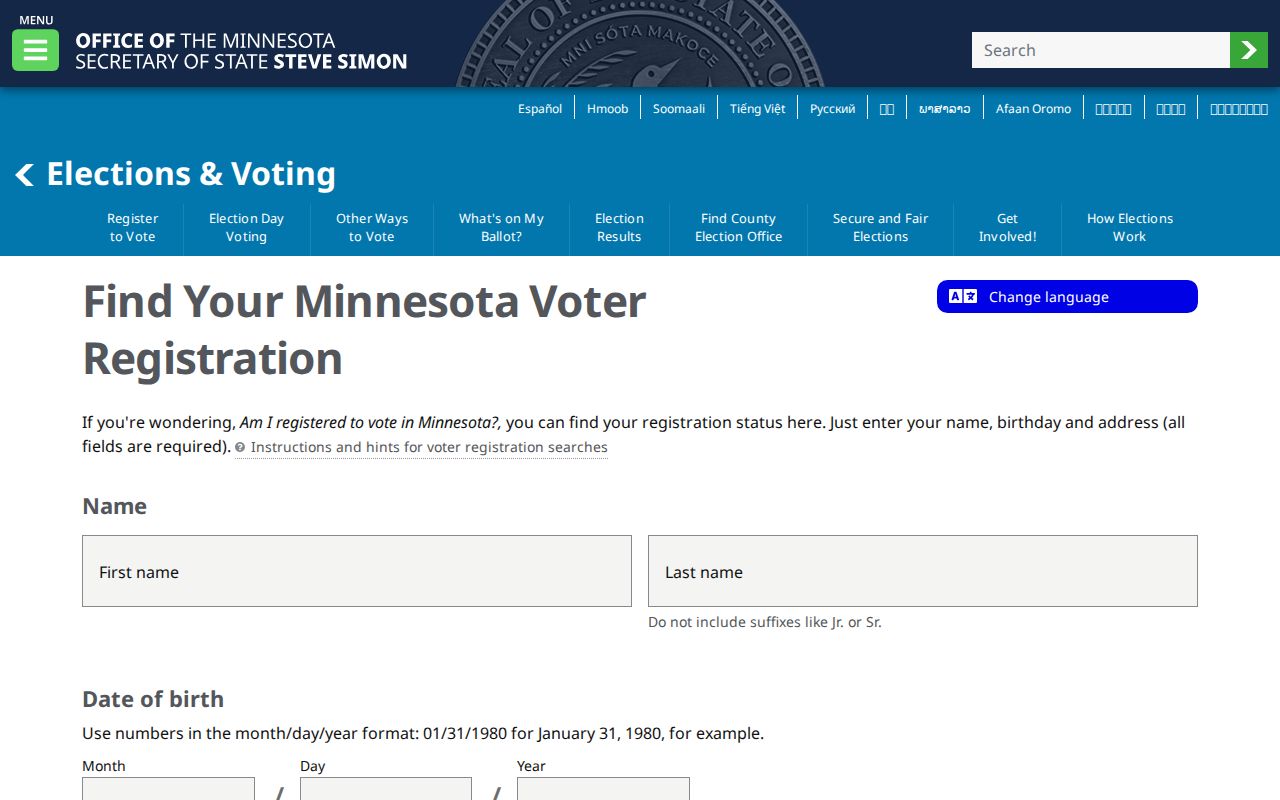
The form’s date-of-birth and address controls support a tightly scoped confirmation. Public voter-list fields are not the same as the full registration file: the 2026 Secretary of State guidance distinguishes public name, address, year of birth, and voting history from restricted full birth date, email, registration method, and identity fields. For address geography, MyBallotMN can return a precinct, district, and polling information, but it does not identify who lives there.
Note: A protected, withheld, or inactivated voter record is a stop signal, not a reason to try alternate spellings or broader searches.
Use MCRO for St. Louis Park Residents
Minnesota Court Records Online, commonly called MCRO, is the statewide court interface for a St. Louis Park name. Its Case Search tab accepts a person, business, attorney, case number, citation number, or attorney bar number. Document Search uses a case number. Hearing Search accepts a person, business, case number, judicial officer, attorney, or bar number, while Judgment Search uses a debtor name. The official instructions favor breadcrumb links within the interface rather than the browser Back button.
The MCRO access rules set an important electronic boundary. Public documents filed on or after July 1, 2015 are generally available online for listed criminal, civil, probate, guardianship, conservatorship, and trust case types. Some public judgments, orders, opinions, and notices from July 1, 2005 through June 30, 2015 can also appear. Family access is narrower, and several protected case types are not complete online. Those are access dates, not proof that the underlying case began then.
The MCRO interface separates case, document, hearing, and judgment search paths.
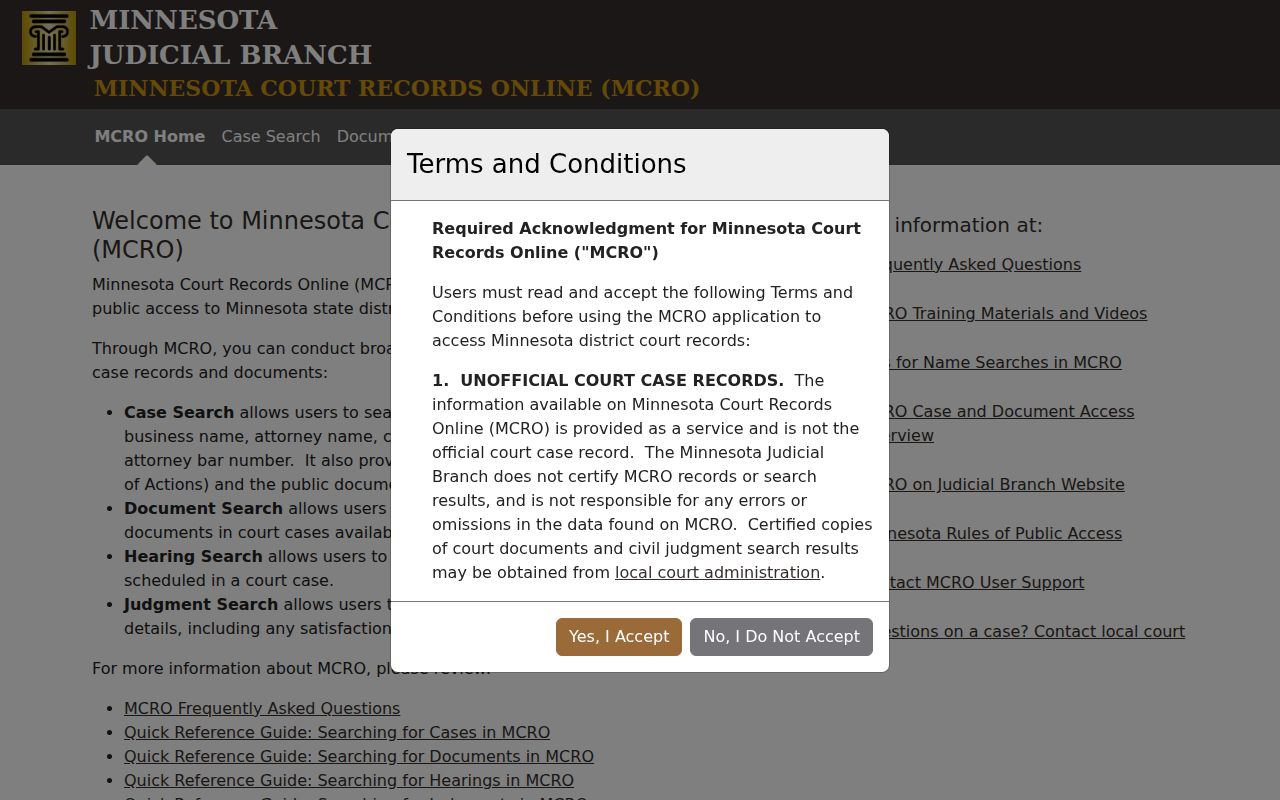
For an older or excluded Hennepin case, the fallback is the Fourth Judicial District. The Hennepin Records Center provides free public-access computers for public case types except juvenile matters, and local paper or counter records may be more complete than online material.
Read St. Louis Park Resident Court Results
A court hit is not a residence confirmation. It is a dated record event associated with a name. The Judicial Branch’s result handout says a Case Search result offers matching case information and a View Case Details button. A Document Search result shows the case number, case title, document name, and a document button. The case-detail screen is the register of actions, meaning the running official record of case events. Save only what is needed to identify the result and its limits.
| Case number | The identifier used for a courthouse request or document search |
|---|---|
| Case title and type | The named case and its category, which are not an address finding |
| Party role | How the person is identified in that case |
| Filing and disposition events | Dated entries in the register of actions |
| Document index and access | A listed index number may exist without an attached public document |
A pending criminal case has a specific name-search limitation: before conviction, MCRO does not return it from a defendant-name search. A case number, citation number, attorney name, or bar number is needed. A no-result can also reflect a sealed, expunged, destroyed, older, or otherwise unavailable record. Keep the searched name, date, tab, wildcard choice, and result count so a later request can be repeated accurately.
Verify a St. Louis Park Resident
Verification means checking whether separate official records point to the same person at the same time, not collecting every available detail. Begin with an address and record its PID or normalized address line. Use a court search only for a relevant public case question. Then use an index or custodian request that matches the period and relationship involved. The following sequence keeps a St. Louis Park resident lookup limited and reproducible.
- Anchor the name to a current or dated address with the Hennepin property result, a directory entry, or an exact voter confirmation.
- Run MCRO with the name as recorded, then repeat a reasonable middle-initial, wildcard, or Sounds Like variant and record the tab used.
- Compare the dated role, case type, or directory year rather than assuming a match of names is a match of people.
- Request a certificate or court copy only from the correct custodian and only when the access rule permits the request.
- Docket
- The court’s dated list of actions and filings in one case, often called the register of actions.
- Index and image
- An index identifies a record or document; an image is the viewable copy. An index entry does not guarantee an online image.
- Certified copy
- A copy issued and authenticated by the custodian for a purpose that requires official certification.
When the evidence points in different directions, retain the conflict. A dated directory line, an owner field, and a current registration result may all be accurate within their own record systems while answering different questions.
Use St. Louis Park Resident Vital Records
Vital records are not a general name directory. Minnesota Department of Health accepts birth and death applications by mail or fax, not by email or electronic application transmission. Minnesota Statutes section 144.225 governs the public and confidential split for birth information. Certified birth copies require an eligible relationship, proof of identity, notarization, or supporting documentation as required by the application. A subpoena alone is not the same as a court order under that rule.
Hennepin County Vital Records is a local issuance route for Minnesota birth records. It describes certified and noncertified options, service timing, an identity-witness alternative, and extra time for some records before 1935. Marriage certificates come from the county that issued the license. The free MOMS marriage index can locate an index entry, but it supplies no certificate image and directs a requester to the custodial county for a copy or correction. Noncertified death-record access follows the county form’s separate rule.
Note: A “No Record Found” response can reflect a spelling, date, indexing, or custodian issue, not a final conclusion about a person.
Check St. Louis Park Resident Business Fields
A public organization filing can help separate a person from a similarly named entity, but it does not establish a private residence. The Minnesota Secretary of State Business Search switches between Business Name and File Number. It offers Begins With or Contains choices, Active or Inactive status, Include or Exclude Prior Names, a search button, and advanced options. The state’s own tips recommend trying a partial name. Treat the resulting entity type, status, filing address, registered-agent field, or prior name as the precise field shown.
The business-search form shows those controlled search options for a St. Louis Park resident lookup.
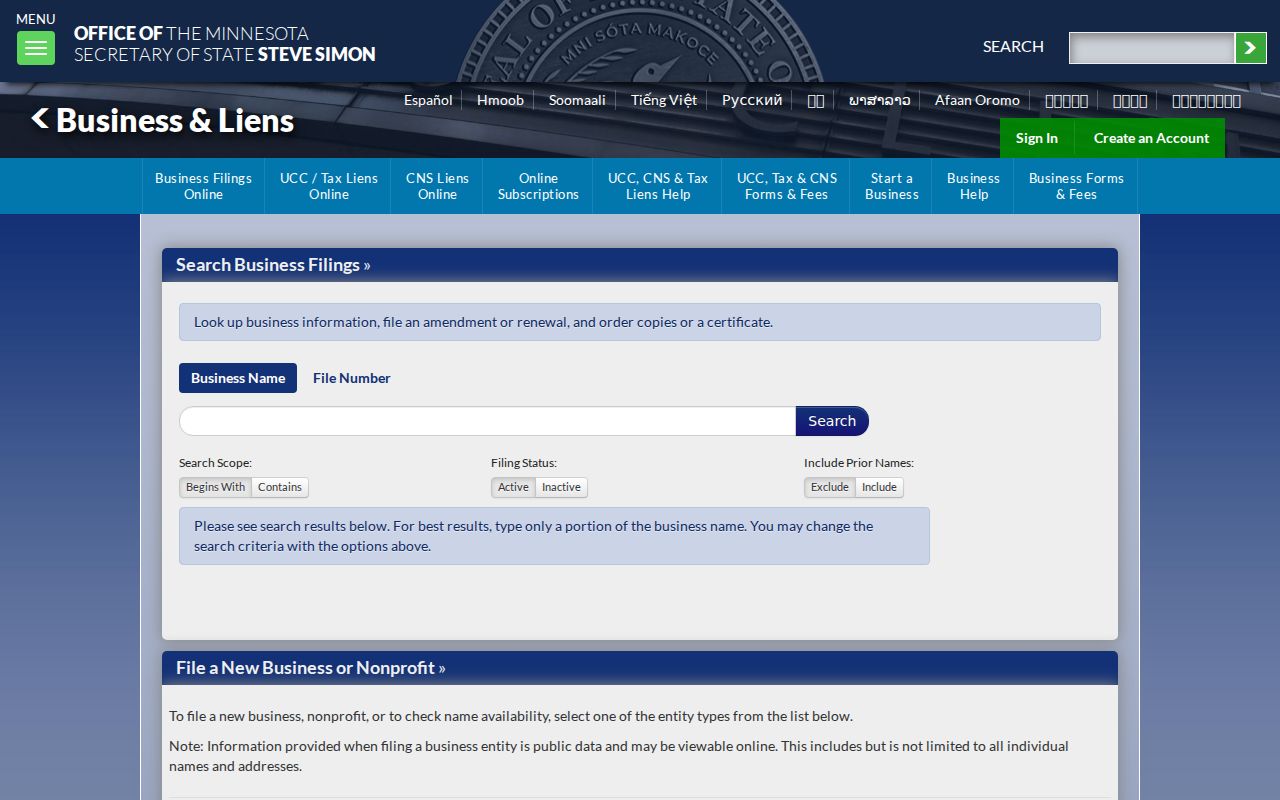
Professional information has separate custodians. The Department of Labor and Industry lookup supports license or registration number, licensee name, company name, DBA, and business or personal filters. A professional-license result should be read for the actual licensee, location, status, or credential displayed, not as an inference that the license holder lives at an address.
Keep St. Louis Park Resident Searches Narrow
Custody tools describe custody status, not a current address. The Minnesota Department of Corrections search covers people under DOC jurisdiction and says records are posted within 48 hours of law-enforcement authorization. The Hennepin jail roster is different: it is an hourly snapshot of people currently in jail or released during the prior seven days. A charge is not a conviction, and neither source is a historical residence list.
The state search route is a separate, limited record class.
Use the result date and the agency’s stated scope. Do not turn a short custody window, a registry notice, or a court event into a broad statement about someone’s history or where they live.
Protect St. Louis Park Resident Data
Minnesota’s Government Data Practices Act, Minn. Stat. section 13.03, begins with a public-data presumption but works alongside record-specific restrictions. Safe at Home, voter withholding, and voter inactivation exist for safety reasons. The Hennepin Elections privacy route identifies those voter options. When a record appears protected, use the custodian’s official contact channel rather than trying to expose a physical address or a restricted field.
The February 2026 Secretary of State guidance is a timely reminder that public voter-list fields and private SVRS fields are not interchangeable. Keep full dates of birth, email, identity numbers, unit details, and protected addresses out of research notes unless an official process requires them. The Safe at Home program protects a designated address for people facing specified safety risks, so a protected result ends the public lookup.
Lawful use. Use a St. Louis Park resident lookup for personal, lawful research. Minnesota law prohibits stalking, harassment, or harm, and protected data must remain with the authorized custodian.
Note: A correction, privacy classification, or record-access question belongs with the agency that created and maintains that record.