
St. Louis Park City Directory Collections
Hennepin County Library is the main starting point for the St. Louis Park city directory shelf. Its digitized City Directory Collection describes a St. Louis Park run from 1933 through 1977 and supports searching as well as browsing. The Historical Society preserves a separate directory and telephone inventory with later holdings and known gaps. Minneapolis Central, Hennepin History Museum, and the Minnesota Historical Society add printed, clipping, map, and archival layers when a digital result is not enough. A directory line is an association published for that volume’s year, not proof that a person still lives at the address.
| Directory collection | Years represented | Where to use it | Access route |
|---|---|---|---|
| HCLIB digitized local directories | 1933–1977 | Hennepin County Library City Directory Collection | Online search and page browsing |
| Historical Society directory and telephone inventory | 1933–34 onward, with gaps and later holdings through 2014 | St. Louis Park Historical Society | Ask about the specific volume |
| Suburban Area directories | 1956–1988, variable coverage | Minneapolis Central | Printed local-history material |
| Directories, clippings, maps, and atlases | Item-specific | Hennepin History Museum | Research by appointment |
Use the date in the table as a collection description, not as a promise that every annual issue survives. The Historical Society inventory lists missing years, including several 1940s and 1950s volumes. A blank is a reason to check another shelf or ask staff, not evidence that a household was absent from St. Louis Park.
Searching the St. Louis Park Directory OCR
The HCLIB City Directory Collection uses a simple-search field, an All fields dropdown, collection checkboxes, and Search or Clear All controls. It reads OCR text, so a no-hit may reflect how a printed page was transcribed rather than an absent entry. Search a surname alone, then search the street address separately. Wildcards work inside a term: * replaces any number of characters and ? replaces one character, but neither can begin a search. The collection does not use ordinary Boolean commands unless they are part of the phrase.
The captured directory collection screen shows the official route for a St. Louis Park historical-directory search.
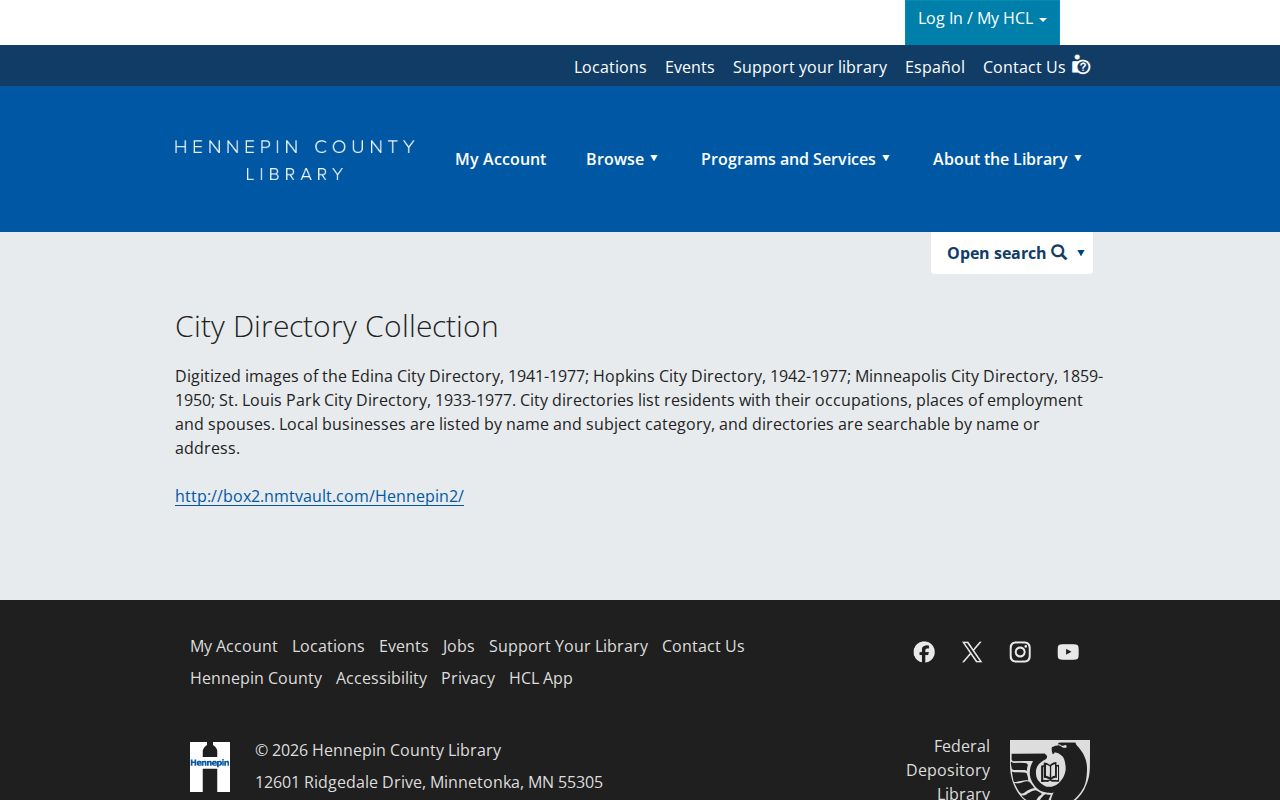
After a result appears, open the page image and record the volume year, printed wording, and page location. That small citation protects against an OCR error and makes a later comparison possible.
Period spelling matters. HCLIB’s search notes say an avenue may appear as Av, street type should be left blank in some address searches, and ordinal streets can vary as 1st, 2d, 3d, or 4th. Keep the search terms that worked with the image citation. Note: OCR is a finding aid, while the scanned directory page remains the record to read.
St. Louis Park Directory Years and Gaps
The St. Louis Park Historical Society traces local directory publication to Lydia Rogers in 1933. Its inventory begins with 1933–34, 1934–35, and 1935–36 volumes, continues through annual or near-annual holdings, and documents missing runs such as 1943, 1946, 1948, 1950, 1953, 1957, and 1959. HCLIB’s digitized description reaches 1933–1977. The society also reports later directory and telephone holdings, so a search after the digitized run should start with the inventory rather than assuming the series ended.
- 1933: Lydia Rogers is identified as the beginning of the local directory era.
- 1933–1977: HCLIB describes the digitized St. Louis Park local run.
- 2015: the Historical Society obtained a digital microfilm reader through a Minnesota Legacy grant.
- Later holdings: the society inventory continues beyond the digitized range, with availability depending on the specific year.
This is also why a directory search should not turn a single year into a continuous life story. Follow the page image forward and backward through nearby years. Where an issue is missing, use newspapers, clippings, yearbooks, maps, or Recorder records to label the gap instead of guessing what happened.
Reading a St. Louis Park Directory Entry
Read each St. Louis Park directory line for the type of association it actually prints. The source-supported local schema is a surname and given name, address, occupation or workplace when present, spouse or household notation, an early resident prefix or mark, and a business name or category for a commercial entry. The official search-tips PDF uses a 1925 Minneapolis example to show format, not a St. Louis Park sample. An exact St. Louis Park entry image was not captured during the research, so a target address should be verified directly in the collection.
| Name line | Surname-first ordering is common; quotation marks may repeat a surname. |
|---|---|
| Address | The printed address is a dated form and may not match modern standardization. |
| Work detail | An occupation, workplace, or business category may appear, depending on the volume. |
| Household notation | A spouse may appear in parentheses, while widow wording or a resident prefix can add context. |
| Source citation | Keep the year and page image before comparing the line with another record. |
- Householder mark
- An early prefix can identify how the person was described in that directory, such as homeowner, householder, boarder, or roomer. It is not a modern ownership record.
- Criss-cross directory
- A directory arranged by address rather than surname. Use it only when a volume actually includes that arrangement.
- Abbreviation key
- The volume’s own explanation of shortened terms. Meanings can change between years, so save the key with the entry image.
Read a mark in the context of the same volume, rather than borrowing a meaning from a later issue. The address, a family notation, and a saved page image are often enough to decide whether a similar name deserves a second search.
St. Louis Park Historical Society Directories
The St. Louis Park Historical Society offers a second route when the directory needs local context. Its web-based Collective Access collection, loaded in 2024 through Minnesota Collections, brings together photographs, documents, business and civic material, school resources, and local artifacts. The office is at 3546 Dakota Avenue, Suite C, and lists Saturday public hours from 1:00 to 4:00 p.m. The historic depot at Jorvig Park is available by appointment or for special events. Contact first when a requested volume, photograph, or newspaper reel is important to the search.
The Historical Society collection entry point is useful for following a St. Louis Park directory find into dated photographs, yearbooks, newspapers, plats, and aerials.
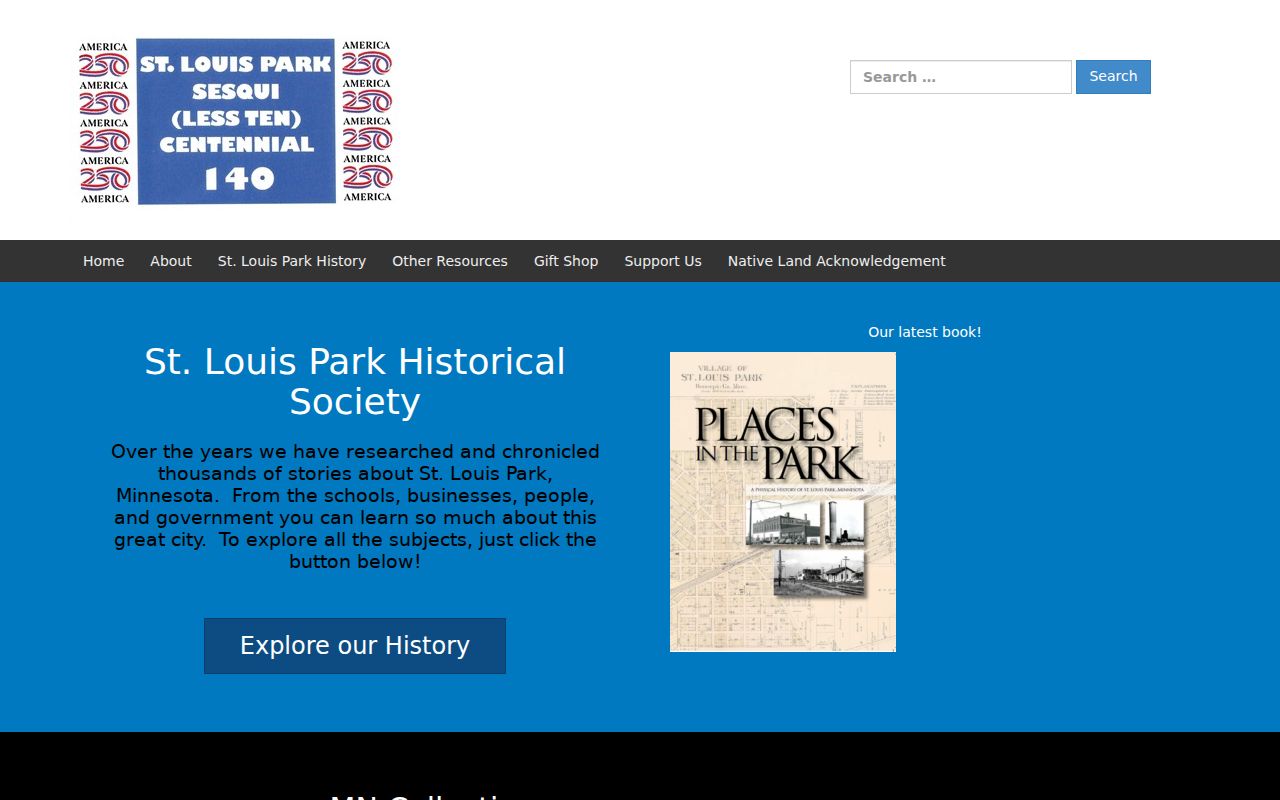
Those materials can supply a middle initial, organization, spouse, business detail, or date that resolves two similar directory names. They corroborate a historical association; they do not establish a present address.
The society reports 37 reels of historic newspapers, an Echo school-paper run from 1946/47 onward with 1929–39 issues missing, yearbooks complete except 2005, and city-donated plat maps and aerial photographs. These layers are especially helpful when the directory inventory has a gap or when an old street label needs a map beside it.
Tracing a St. Louis Park Directory Household
A household trail works best when it is slow and dated. Start with one confirmed surname or printed address, then compare the surrounding years without silently filling missing volumes. The HCLIB home-history research path connects directories with clipping files, neighborhood newspapers, Recorder documents, Just Deeds, and library databases. If the aim shifts to current address-keyed records, use the separate St. Louis Park Street Directory method instead of treating an old listing as current evidence.
- Find the earliest clearly matching name or address and save the page image and year.
- Check nearby directory years for address, household wording, occupation, and spelling changes.
- Search the address as well as the surname, using historical OCR forms such as
Avwhere needed. - Pair the directory years with the census year and other dated sources appropriate to that period.
- Use clippings, maps, or archival items to explain a move or resolve a same-name problem.
A disappearance can mean a move, death, an unlisted household, a changed spelling, or a collection gap. A name should be carried forward only when the address, household detail, page image, or another independent source supports the match. Note: a sequence of directory entries is stronger when each year and source image is preserved.
St. Louis Park Directory Research Rooms
Not every useful volume is online. The St. Louis Park Library at 3240 Library Lane lists local-history assistance, computers, and licensed resources; its stated hours include Sunday noon to 5:00 p.m., Monday 9:00 a.m. to 5:00 p.m., Tuesday through Thursday noon to 8:00 p.m., and Friday through Saturday 9:00 a.m. to 5:00 p.m. Minneapolis Central holds printed Suburban Area directories and clipping files. Hennepin History Museum provides directory volumes, Sanborn maps, atlases, clippings, yearbooks, and more by appointment.
Bring a bounded request: the address as printed, possible surname spellings, the years sought, and a known PID or legal description if the research becomes a house-history question. Minnesota Historical Society collections add maps, photographs, oral histories, naturalization microfilm, Hennepin civil case files, and archive material under their own retrieval rules. A directory is one shelf in that wider St. Louis Park record history.
St. Louis Park Directory Evidence Limits
Directories answer a narrow but valuable question: what did a publisher print about an address or person in a particular year? They do not prove current occupancy, a full household, title, or an uninterrupted stay. Compare role and date before merging facts. A directory association, a deed party, an assessor owner or taxpayer field, a map footprint, and a municipal record each describe different things. For a title event, the Hennepin Recorder/Registrar and its authorized copy routes are the controlling source.
Use local history for family research, reunion work, estate questions, or a careful house history. Do not use historical details to pursue, harass, or harm a living person. Minnesota’s public-data and confidentiality rules can limit access even when a name appears in an older printed volume.